


Bend Allowance in Formed Parts
Under Construction
This page is currently under construction. Below is a technical overview of bend allowance, how it is calculated, and the impact of material type on press brake forming. Understanding bend allowance is critical for accurate flat pattern development, minimizing scrap, and ensuring formed parts meet final dimensions.
What Is Bend Allowance?
When sheet metal is bent, the material does not simply fold at a sharp corner. The inside of the bend is compressed while the outside stretches. Between these two zones lies the neutral axis, where the material neither stretches nor compresses.
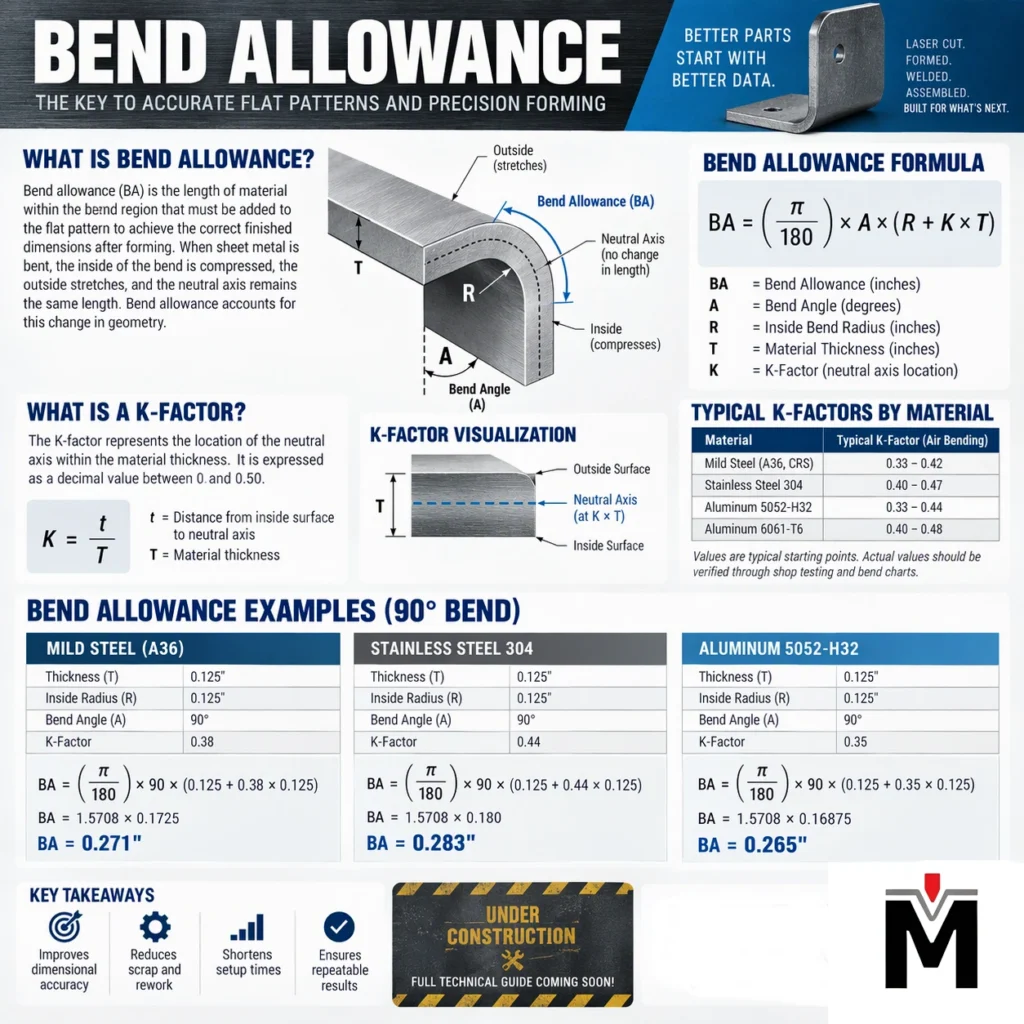
Bend Allowance (BA) is the length of material within the bend region that must be added to the flat pattern to achieve the desired finished dimensions after forming.
Without proper forming allowance calculations, parts may end up too short, too long, or fail to meet critical dimensional requirements. Learn more about Local and Global Formability ->
Forming Allowance Formula
The standard flat pattern for press brake formula is:
BA=(180π)×A×(R+K×T)
Where:
| Variable | Description |
|---|---|
| BA | Bend Allowance |
| A | Bend Angle (degrees) |
| R | Inside Bend Radius |
| T | Material Thickness |
| K | K-Factor |
What Is a K-Factor?
The K-Factor represents the location of the neutral axis within the material thickness.
K=Tt
Where:
- t = Distance from inside surface to neutral axis
- T = Material thickness
The K-factor is expressed as a decimal value between 0 and 0.50.
Understanding K-Factor
| K-Factor | Neutral Axis Location |
|---|---|
| 0.30 | Closer to inside surface |
| 0.40 | Typical for air bending |
| 0.50 | Center of material thickness |
The exact K-factor varies based on:
- Material type
- Material hardness
- Bending method
- Tooling geometry
- Inside bend radius
- Press brake setup
For precision fabrication, manufacturers often develop material-specific bend tables through testing rather than relying solely on theory.
Typical K-Factors by Material
The following values are commonly used starting points for air-formed parts:
| Material | Typical K-Factor |
|---|---|
| Mild Steel (A36, CRS) | 0.33 – 0.42 |
| Stainless Steel 304 | 0.40 – 0.47 |
| Aluminum 5052-H32 | 0.33 – 0.44 |
| Aluminum 6061-T6 | 0.40 – 0.48 |
Actual values should be verified through shop testing and bend deduction charts.
Mild Steel Example
Mild Steel Bend Allowance
Material Thickness: 0.125″ (11 gauge approx.)
Inside Radius: 0.125″
Bend Angle: 90°
K-Factor: 0.38
BA=(0.017453)×90×(0.125+(0.38×0.125))BA=1.5708×0.1725BA=0.271 inches
Bend Allowance = 0.271″
Example in Stainless Steel
Stainless Steel 304 Bend Allowance
Material Thickness: 0.125″
Inside Radius: 0.125″
Bend Angle: 90°
K-Factor: 0.44
BA=1.5708×(0.125+(0.44×0.125))BA=1.5708×0.180BA=0.283″
Bend Allowance = 0.283″
Because stainless steel typically exhibits greater resistance to deformation and different neutral axis movement, the bend allowance is often slightly larger than mild steel.
Examples in Alum
Aluminum 5052-H32
Material Thickness: 0.125″
Inside Radius: 0.125″
Bend Angle: 90°
K-Factor: 0.35
BA=1.5708×(0.125+(0.35×0.125))BA=1.5708×0.16875BA=0.265″
Bend Allowance = 0.265″
5052 aluminum is commonly preferred for formed components because of its excellent ductility and reduced cracking risk compared to harder aluminum grades.
How Material Type Affects the flat pattern
Mild Steel
Mild steel is generally predictable and forgiving during forming operations. It offers consistent bend characteristics and is commonly used as the baseline material when developing bend charts.
Common Grades
- A36 Hot Rolled Steel
- Cold Rolled Steel (CRS)
- Galvanized Steel
Stainless Steel
Stainless steel experiences greater springback than mild steel and often requires additional tonnage to achieve the desired angle.
Common Grades
- 304 Stainless Steel
- 316 Stainless Steel
Considerations
- Higher springback
- Greater forming force
- More variation between tempers
Aluminum
Aluminum’s bending behavior varies significantly by alloy and temper.
Common Grades
- 5052-H32 (excellent for forming)
- 6061-T6 (limited formability)
Considerations
- Lower forming force
- Greater springback
- Potential cracking on harder tempers
Why Bend Allowance Matters
Accurate forming allowance calculations help:
- Produce accurate flat patterns
- Reduce scrap and rework
- Improve dimensional consistency
- Shorten setup times
- Improve repeatability between production runs
- Ensure OEM components meet print requirements
For production manufacturing, most fabricators supplement theoretical calculations with proven bend deduction charts and shop-tested material data to maintain repeatable forming accuracy.
Need Help With a Formed Part?
METCO Metal Fabrication provides CNC press brake forming services for mild steel, stainless steel, and aluminum components. Our team develops material-specific bend allowances and bend deductions to ensure flat patterns produce accurate finished parts while minimizing manufacturing risk.